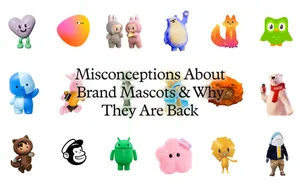
Misconceptions about brand mascots, and why they are back
Labubus, Sonny Angels, animal bag charms and AI “emotional pets” aren’t random micro-trends, they’re cultural signals.
In a climate defined by uncertainty, “pet-coded” design and mascots act as emotional artifacts: they create a sense of safety, warmth, and continuity. The rise of cute objects also reflects a shift in identity: small, collectible characters become portable personality markers. And as technology becomes more complex and present, brands increasingly wrap it in friendly, approachable forms.
It’s no surprise that brand mascots are returning, not as nostalgia, but as contemporary brand assets built for products, platforms and culture, responding to emotional needs in society. If your instinct is still “not for us”, it’s probably because you’re picturing an outdated version: a static cartoon or a forced “fun” tone that undermines the brand’s credibility.
The current wave is different. Today’s mascots are dynamic, digital-first assets designed to scale, connect and evolve. They can guide the customer journey, activate the brand in real spaces, humanize campaigns without diluting authority, power playful content and make the brand more tangible and memorable.
Before ruling them out, it’s worth revisiting five common misconceptions:
1) “Mascots are passé”
It’s easy to associate mascots with an earlier era of branding. But their resurgence is less about nostalgia than context. We’re seeing mascots appear in refreshed brand systems, such as Firefox’s recent introduction of Kit and in contemporary cultural brands like FC Barcelona’s CAT.
AI is accelerating the shift toward character-driven digital experiences. As products become more conversational, characters provide a warmer and clearer interface between brands and users. Headspace’s Ebb or Notion’s AI agents show how digital products increasingly behave like collaborators rather than just tools.
Gamification reinforces the trend. As apps introduce progression loops and rewards, mascots naturally embody motivation, guidance and feedback. Even in sectors that aren’t traditionally playful, like healthcare, this shift is visible. The French digital health insurer Alan app, for example, expanded the role of its mascot as its product became more gamified, turning it into a driver of engagement.
The broader cultural signal is the growing acceptance of playful identity markers. Collectible characters, charms and companion objects, like Labubu or Mirumi, suggest that “cute” is no longer synonymous with childish, it’s a reflection of the zeitgeist. The same impulse shows up in fashion: mascots have resurfaced through streetwear in retro restaurant-style promotional tees, playful, logo-plus-character graphics that brands of all kinds have embraced as wearable identity.
Conception: Reality has already confirmed their cultural relevance.
2) “Mascots are only a visual device”
A mascot becomes decorative when it has no role. When it has a role, it becomes strategic.
Well-designed mascots help brands make complexity easier to navigate, build narrative depth and stand apart in crowded markets. Salesforce’s character universe, for example, helps make a vast platform feel more approachable and engaging.
Mascots also carry meaning through their creation process. The way a character is designed doesn’t simply define how it looks; it signals what the brand stands for. Barcelona 92’s Cobi by Javier Mariscal didn’t just represent the Olympics, it reflected an alternative, culture-forward attitude into how the city presented itself.
In social channels, mascots also add storytelling by acting as brand ambassadors. TikTok, in particular, has become a space where brand characters bring consistency, entertainment, and cultural relevance, participating in trends and memes while giving the channel a recognizable voice. In those cases, like Ryanair’s face, the mascot isn’t supporting the content strategy, it is the content strategy.
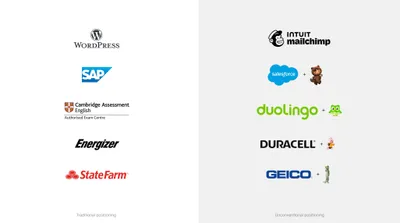
Choosing to have a mascot is a visible cue that a company isn’t playing by the category’s usual rules: less establishment, more personality, more edge. You can see that contrast in brands like Mailchimp vs. WordPress, Salesforce vs. SAP, Duolingo vs. Cambridge English, or Duracell vs. Energizer, where personality becomes part of the competitive distinction.
Conception: They build narrative and positioning, not just visuals.
3) “Mascots are tacky”
“Tacky” is rarely about the character itself but about misalignment: the wrong aesthetic, the wrong tone, or a character performing the wrong job.
People respond naturally to faces and personalities: they create social connection and add an emotional dimension that logos and systems often can’t. Android’s Bugdroid became iconic precisely because it felt open, friendly and adaptable without undermining the brand’s technical credibility.
The idea that mascots automatically cheapen a brand also falls apart when looking at luxury. Cartier’s panther has been a recurring motif since the early 20th century, while Louis Vuitton introduced Vivienne in 2017 as a contemporary character embedded in its creative universe. In both cases, character symbolism reinforces desirability rather than diluting it.
Importantly, mascots can unlock collectability and merchandising, allowing brands to enter more intimate spaces such as homes, desks and wardrobes, where identity is expressed. That shift from recognition to identification is rarely accidental.
Conception: Emotional resonance is one of the most valuable signals, not a cheap one.
4) “Mascots reduce professionalism”
Even in complex industries and B2B contexts, they can also help bring clarity.
Mailchimp is a well-known example: its mascot humanizes a highly technical service without compromising capability. Even cloud and infrastructure brands use mascots in educational and onboarding contexts to make learning more accessible.
The real risk isn’t the mascot, it’s lack of governance. Fatigue happens when a character is omnipresent without a clear purpose. The best mascot systems can be truly transversal, integrated across the brand with a strong role. But there’s another equally valid model: mascots designed for specific contexts, deployed to solve a clear strategic need.
Connecting with a particular audience, such as child-friendly airline mascots like Lufthansa’s Lu and Cosmo.
Helping a brand feel culturally native in a specific market, like IKEA’s Blåhaj in Japan.
Acting as seasonal awareness accelerators, as with Coca-Cola’s Santa.
Adding desirability to a specific layer of the brand experience, like loyalty mascots such as Piraeus’ “Yellow”.
Becoming a content pillar within a single channel, like easyJet’s Croc Monsieur.
Representing the brand only in a specific environment or product world, such as Dropbox’s crypto project mascot, Drop.
Professionalism isn’t undermined by a mascot. It’s undermined by poor governance: inconsistency, misuse and overexposure.
Conception: Mascots need intent: Role first. Character second.
5) “Mascots are only external”
Mascots often become more powerful internally than brands expect.
Within organizations, they can act as cultural anchors: shared symbols that teams rally around. They appear in onboarding materials, town halls, team events, office environments and the small everyday rituals that reinforce belonging.
Because values are experienced through symbols and behaviours, not statements in a pdf, a mascot can embody “how we act” far more effectively than guidelines alone. This becomes especially relevant in periods of growth, transformation, or distributed work, where shared reference points become harder to maintain.
Used thoughtfully, a mascot becomes a unifier rather than a distraction, internally as much as externally.
Conception: They’re internal glue: belonging, pride and ritual.
Mascots are experience engines
A mascot isn’t a costume, it’s a behavior layer: how a brand shows up, not just how it looks. Logos identify. Design systems organize. Tone of voice guides. A mascot adds presence: a consistent way to deliver warmth, clarity and engagement across product, culture and communication.
Mascots shouldn’t be automatic, but they shouldn’t be dismissed either. In today’s landscape, the right character (well designed, well governed and built with a clear role) can be one of the most versatile brand assets a company can develop.
Words: Anna Martorell, Senior Brand Strategist & Insight Leader.
The mascots referenced in this article come from a range of sectors, brands and agencies, and have served as a source of inspiration and analysis for this piece.