The strategic life of a brand name
The brand name is not a sacred asset, it’s a strategic one.
A core element to revisit over time
Brand names were once treated as permanent. Chosen at the start, locked in legally, and protected at all costs. That logic made sense in a world where brands evolved slowly, categories were stable, and growth followed predictable paths. And while it remains true that changing a name is still the most radical brand decision, because it can mean becoming another brand, permanence is no longer the default strategy, accuracy is.
Today, brand names are less static than once assumed. They are recognized as a key brand strategic asset that can deliberately evolve when the organisation or the positioning itself changes. This is not about rebranding for novelty, but about using naming as an active tool to support growth, repositioning, and long-term relevance.
A brand name doesn’t define the brand, the brand should define its name
Names don’t become wrong or suboptimal overnight. They become misaligned as a business expands beyond its original scope, the context evolves, or the organization outgrows the category embedded in its name. When that happens, holding on to a name at all costs doesn’t protect the brand, it freezes it.
Often, naming evolutions don’t start with a desire to change the name itself. They emerge from a strategic diagnosis that reveals friction, constraints, or untapped opportunities. Because a brand name reflects what a brand stands for, when that meaning shifts, it’s only logical for the name to evolve as well. A strong example is Magnific (formerly Freepik), which rebranded this year as it evolved from a stock asset search engine into a comprehensive AI-powered creative platform, outgrowing a name that no longer fully reflected its offering.
With brand names, you can do more than just create them: they can be changed, shortened, or refined, for different strategic reasons. Sometimes the change reflects a fundamental shift within the company; others simply respond to the need to adjust tone or clarify the brand’s relationship with its parent.
Some recent examples developed by Mucho illustrate how different these motivations can be:
Piraeus
(formerly Piraeus Bank)
Dropping Bank was a statement of confidence, placing the brand among those whose authority is assumed rather than explained. The brand had reached a level of recognition and institutional trust where category definition was no longer required, while also allowing it to grow beyond traditional banking. The shorter name also allows the brand to operate more fluidly across digital environments and to gain visual clarity and iconicity.
Occident
(formerly Catalana Occidente, Plus Ultra, Seguros Bilbao and Norte Hispana)
A strategic evolution driven by portfolio growth. As the Catalana Occidente group integrated companies with different origins across Spain, the reference to Catalana became less representative of the whole. The shift to Occident enabled brand consolidation under a neutral master brand, simplifying the architecture and allowing it to operate as a unifying umbrella across diverse businesses.
IAAC Advanced Architecture Barcelona
(formerly IAAC Institute for Advanced Architecture of Catalonia)
Moving beyond the literal meaning of the acronym allows the name to function less as an explanation and more as a positioning device. By choosing Barcelona over the institutional name, the city becomes a global signal of culture and innovation.
Jungle
(formerly Jungle21)
A naming decision driven by brand architecture. As the group expanded and incorporated multiple companies, the numerical reference no longer made sense. Dropping it allowed Jungle to act as a group brand, without privileging a single entity.
Alianza
(formerly Alianza Editorial)
Removing “Editorial” allows Alianza to move beyond its perception as a publishing house while preserving the cultural legacy built over six decades. The shorter name gives the brand greater scope to express its cultural ambition, connecting generations of readers, ideas and contemporary culture.
CATEB, Col·legi de l’Arquitectura Tècnica de Barcelona
(formerly CAATEEB, col·legi d’Aparelladors, Arquitectes Tècnics i Enginyers d’Edificació de Barcelona)
Not a cosmetic change, but a response to the obsolescence of a professional nomenclature that no longer represented how the profession was named itself today. The update resulted in a shorter name, a practical advantage in itself.
IAAC Advanced Architecture Barcelona
(formerly IAAC Institute for Advanced Architecture of Catalonia)
Moving beyond the literal meaning of the acronym allows the name to function less as an explanation and more as a positioning device. By choosing Barcelona over the institutional name, the city becomes a global signal of culture and innovation.
When less says more: dropping descriptors
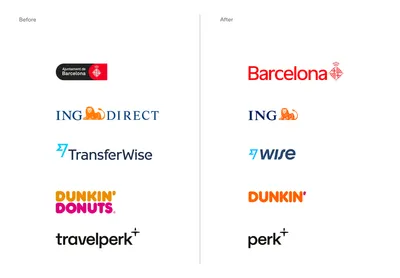
One of the most visible and common ways brand names evolve today is through the removal of descriptors. Many of the elements that once accompanied company names have quietly fallen away: organizational labels (“Group”, “Holding”, “Corporation”, “Ventures”, “.com”), industry descriptors (“Bank”, “Foods”, “Editorial”, “Services”), geographic qualifiers (“International”, “Global”, “Paris”), and even founders’ full names.
What was once used to explain, reassure, or legitimize has become noise in a brand landscape where meaning is built through presence, behavior, and context rather than labels. Thus, naming can focus on impact and distinction rather than explanation.
Descriptors can be useful in a brand’s early stages, helping people understand what a business does and how it operates. But names rarely exist in isolation; they appear across products, interfaces, communications and experiences that give them meaning. People don’t rely on the name to understand the category; the brand’s behaviour does that work. Meaning is carried through action and experience, not category definition.
Brands drop descriptors when they no longer add value or limit the brand perception, locking the brand into a single function, category, or moment in time. Removing them leaves room for growth and flexibility, allowing the brand to diversify, expand its offer, and move beyond a product-led perception.
When descriptors disappear, the benefit is not only strategic but also practical. Shorter names tend to behave more iconically: they are easier to recognize, remember, and harder to ignore, carrying greater presence and authority. Reduction is not about saying less, but about saying it with more force. Besides, from a practical standpoint, shorter names deploy more effectively across digital environments and scale more naturally across products, markets, and platforms.
We’ve seen this quiet signal of brand maturity locally and globally, across different industries:
Barcelona
(formerly Ajuntament de Barcelona) (2025)
The institution dropped its administrative descriptor to operate under the city’s name. By doing so, it reinforces a stronger sense of belonging and a closer link between the city and the institution. In practice, context does the rest: when the Barcelona logo appears, it is naturally understood as an initiative promoted by the city council.
Perk
(formerly TravelPerk) (2025)
The brand dropped Travel to reflect its evolution beyond a single category. What began as a business travel management platform had expanded into a broader workspace for managing employee expenses, benefits, and company operations. The shift from TravelPerk to Perk expresses a more flexible value proposition — retaining the idea of efficiency and smart benefits under a name designed to support a wider, more durable ambition.
ING
(formerly ING Direct) (2023)
ING progressively dropped Direct since the descriptor had become misleading in an omnichannel reality where “direct” was no longer a differentiator. The change reflects brand maturity and the normalization of digital banking.
Rabanne
(formerly Paco Rabanne) (2023)
The brand dropped the founder’s first name to modernize its expression and operate as a contemporary fashion house rather than a legacy designer label. The move signals continuity without nostalgia and positions the brand beyond the founder’s persona. As with descriptors, the personal name became the expendable element: less distinctive and no longer essential to the brand’s meaning.
Strong brands don’t need to explain what they are. They show it, consistently over time.
Changing, shortening, or refining a name isn’t a loss of clarity. It is often the clearest signal that a brand now operates at a more strategic level, beyond the functional one.
If your brand has evolved, has your name kept up, or is it quietly holding you back?
Explore more of our naming projects.
Words: Anna Martorell, Senior Brand Strategist & Insight Leader.